Wednesday, 26 March 2014

Shape Bingo

AusVELS Mathematics – Foundation
Measurement & Geometry – Shape

 
Shape Bingo includes 8 placemats with a variety of graphics representing two dimensional shapes and three dimensional objects. Shape Bingo has three sets of Bingo Cards… shape names (one set with picture clues and one without) and shape clues – use one set at a time or all at once (include only 1 or 2 ‘Free’ cards when using all).
 
Print placemats and cards in colour and laminate.
 
http://www.teacherspayteachers.com/Product/Shape-Bingo-1177521
To play Shape Bingo…
 
  • Groups can have up to 9 students playing – 1 to shuffle and show Bingo cards (this student will need assistance from an adult), 8 with Shape Bingo placemats
  • Ensure students have time to look at their Shape Bingo placemats and discuss the shapes they have
  • Elect one person to shuffle and show the Shape Cards one at a time. Students use a counter to mark off one matching shape/object they have on their placemat. Cards that have been shown are placed in a neat pile and will be used at the end of the game to check the winner’s Bingo placemat. Cards can be shuffled and re-used if no one gets 3 in a row
  • When students have 3 in a row - they call out ‘BINGO!’
  • The person showing the Shape Cards checks their shapes – if they are all correct, they are the winner. Students swap roles and placemats, then play again
  
http://www.teacherspayteachers.com/Product/Shape-Bingo-1177521 
 http://www.teacherspayteachers.com/Product/Shape-Bingo-1177521    http://www.teacherspayteachers.com/Product/Shape-Bingo-1177521
 
 
Variations…
  
  • Students can match the whole Shape Bingo placemat before calling out ‘BINGO!’
  • Set a time limit for how long each Bingo Card is shown for e.g. 10 seconds
  • Speed Bingo – game runs for 3 minutes, cards are only shown for 3 seconds at a time, player with the most counters at the end of the 3 minutes is the winner (an adult can show the cards - as they need to keep track of the time – alternatively, set a timer for three minutes)
  •  Include ‘Free’ Shape Cards in the pack – students must be able to correctly say the name of the shape or object they are putting the free on before placing a counter on that square
  •  Placemats and Shape Cards can also be used as a matching activity
 
We hope you enjoy the latest addition to our Bingo collection - please let us know if there are any other topics you would like to see included!


Sunday, 23 March 2014

Snake and Ladders......


Snakes and Ladders is a great game to play for subitising collections on dice, counting on and taking turns


There are many different boards around and if you can, it is a great idea to use a variety of them. 

Student's also like making their own boards. 

Here is an online game (free) you may like to use. 

It is from COUNT ON


Have a great week

Wednesday, 19 March 2014

Year Two Tracking document and pack


there are 32 pages in this pack
including
 
Number and Algebra – 11 pages
Measurement and Geometry – 10 pages
Statistics and Probability – 4 pages
Record your student names on each sheet
Decide what tasks you will use to assess each elaboration. This will show what the student had achieved within each of the Content Descriptions
The information you collect can be used to assist in individual goal setting and planning for focus teaching of individuals or groups
Use the appropriate level for each student. If the student is above the level they need to be accessing the level that is appropriate for them
This may mean that you have multiple levels within the one grade
The positive outcome is that each student will be challenged appropriately


Packs for Year Three and Four are almost done. Year Five and Six are our next projects!
 

Sunday, 16 March 2014

Multiplication Toss - Sunday Night Game


This week we are sharing a game called "Multiplication Toss" also known as 'Paddocks'.

This is great for teaching times tables, arrays and area. 

I love that you encourage kids to record the two dice as one numeral and one word - this makes explicit links to arrays.

You can get a copy of the document if you follow this link or click on the document image.


Wednesday, 12 March 2014

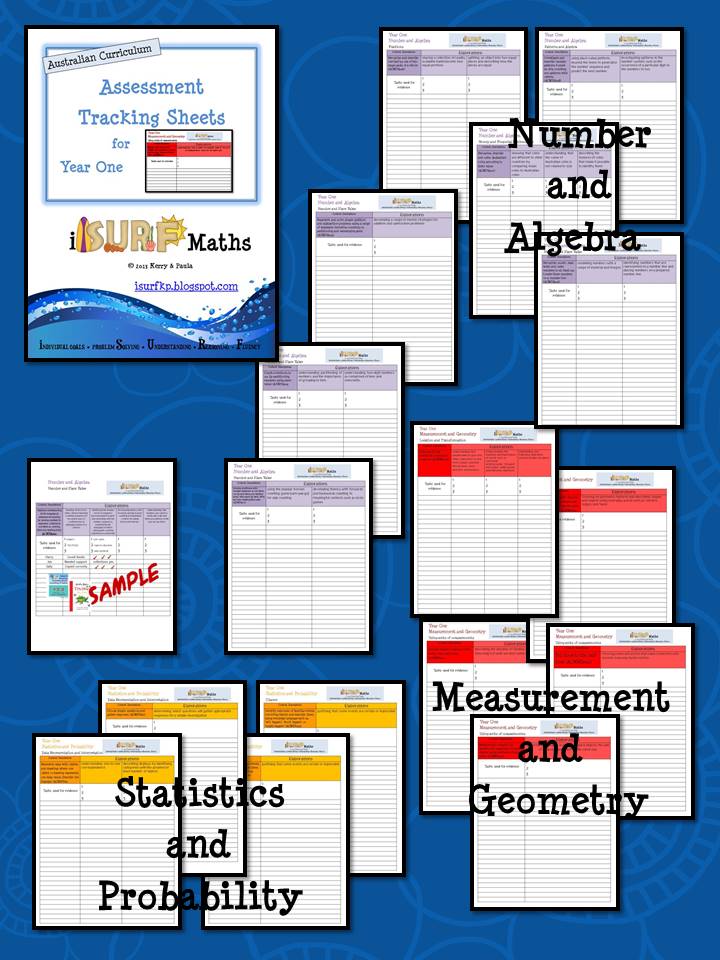
Tracking at Year One Level

We have started to add to our series of tracking documents.
The second in the series is 

22 pages

which includes 

MAKING CONNECTIONS and INSTRUCTIONS - 1 page

RECORDING SHEETS
Sample – 1 page
Number and Algebra – 7 pages
Measurement and Geometry – 5 pages
Statistics and Probability – 4 pages

Record your student names on each sheet
-          Decide what tasks you will use to assess each elaboration. This will show what the student had achieved within each of the Content Descriptions
-          The information you collect can be used to assist in individual goal setting and planning for focus teaching of individuals or groups
-          Use the appropriate level for each student. If the student is above the level they need to be accessing the level that is appropriate for them
-          This may mean that you have multiple levels within the one grade

-          The positive outcome is that each student will be challenged appropriately 


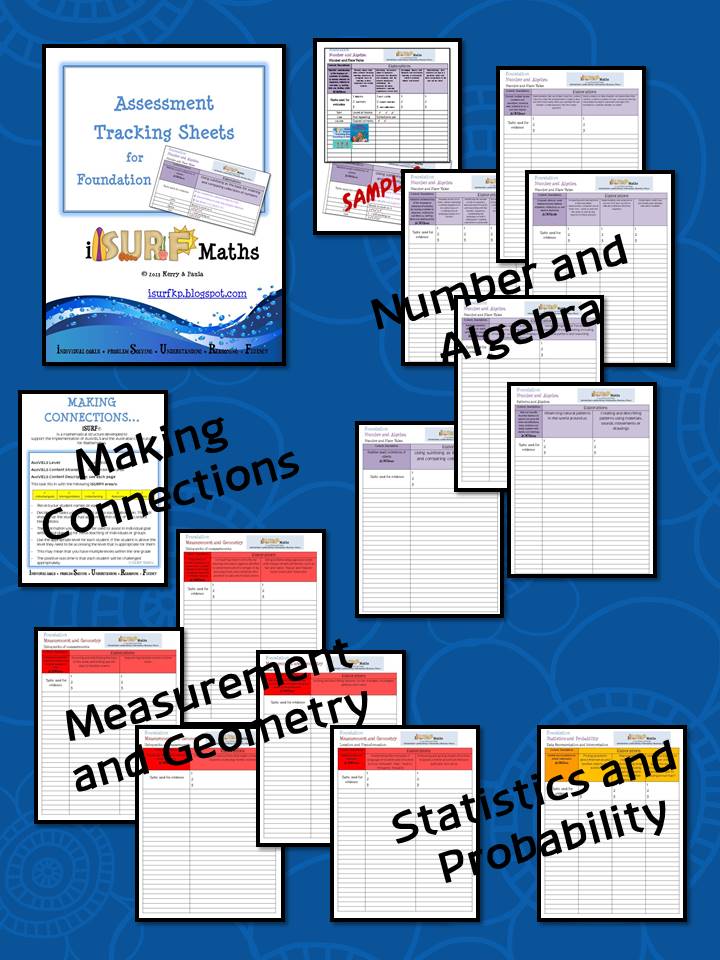
Just a reminder that are Foundation set is also ready


Sunday, 9 March 2014

St Patrick Day game freebie


On our facebook page there is a freebie. 

Students love 'Roll and Cover' games. This freebie is a simple one. 
There are three different mats to use.
With a 6 sided dice - roll
Count or subitise the dots and then find the numeral to match.
Cover with a counter and roll again. 

These are great for number sense and trusting the count.
Click here or on the images below to access our facebook page.
Like our page
Click on the Welcome tab and click the cover to download from google docs. 

This will be available for a few weeks and then be removed - it will be replaced by an Easter freebie


Wednesday, 5 March 2014

What's The Chance?

AusVELS Level 3 & 4
Statistics and Probability - Chance
 
This week we are adding a unit of work to our shops based on the topic of Chance.
http://www.teacherspayteachers.com/Product/Whats-The-Chance-1144838
 
As students explore the idea of chance, it is critical they develop an understanding of the link between the number of possible outcomes and the likelihood of an event occurring. 
 
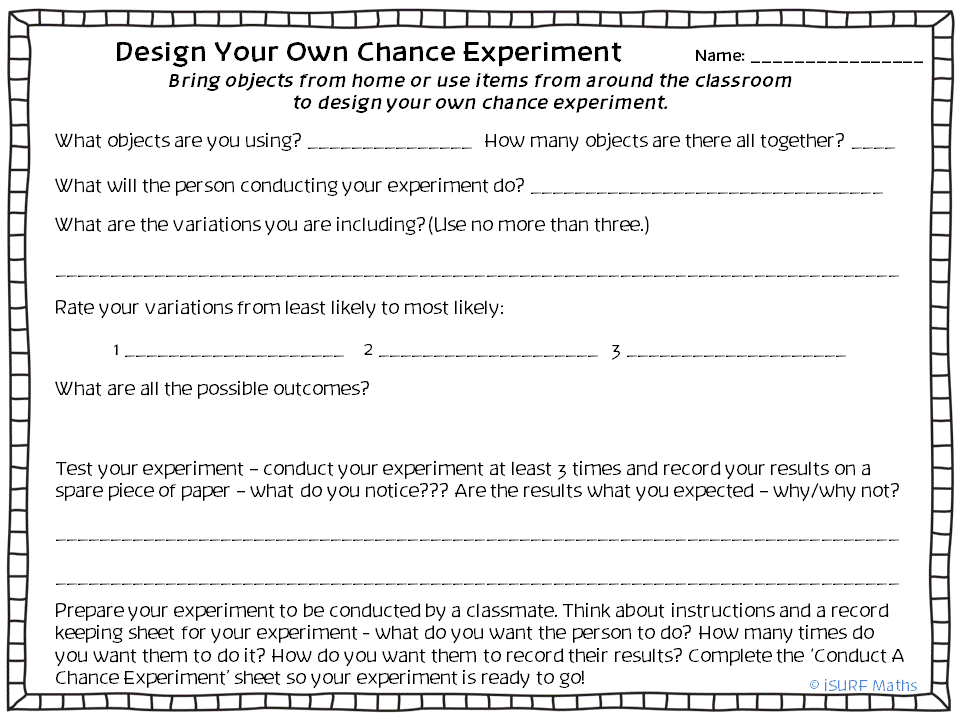
This unit of work allows students to conduct experiments, examine outcomes, evaluate the likelihood of an event and design their own chance experiment.
 
Read through the weekly planner to know what the relationship is between the different parts of the lesson and the resources. This pack contains 25 pages. Although designed to be conducted over one week, depending on time available, student progress and other experiments you may wish to include – this unit may take longer to complete.
Tasks included:
  • Chance Word Wall
  • Flip me!
  • Roll Me! (extension task)
  • How Likely?
  • How Likely? (Part 2) (standard or extension task)
  • Design Your Own Chance Experiment!
  • Conduct A Chance Experiment
  • Feedback on Design Your Own Chance Experiment
http://www.teacherspayteachers.com/Product/Whats-The-Chance-1144838  http://www.teacherspayteachers.com/Product/Whats-The-Chance-1144838
 
Assessment:
  • Use the Student Progress Record to track student’s progress against both the success criteria and AusVELS standards.
  • Collect work samples - make anecdotal notes on which students need support.
  • Level 3 – Collect Flip Me and Roll Me experiments, along with any further experiments conducted by students
  • Level 4 - Evaluate ‘Design Your Own Chance Experiment’ Task using Learning Intentions, Success Criteria and AusVELS

We hope you find this a useful addition to the units we already have posted.
Please feel free to contact us with your feedback or requests!
 

Sunday, 2 March 2014

Sunday Night Games

This week we are continuing our series on card games for the classroom. The games we are posting are suitable for students in Year (Grade) One & Two.
As always, lots of modelling, discussion of the rules and how to be a good winner/participant is critical before students play the games independently.
Have fun!

War
Number of players: 2
Cards: remove picture cards from a standard deck of 52 cards

How to play:
All number cards are dealt to the two players and kept face down. Neither player looks at their cards. Both players turn over the top card in their pile and put it face up in the centre of the table (beside the other player’s card).

The first person to add the two cards together wins that war, they take the two cards and add them to the bottom of their pile. (You may wish for some students to use a calculator or concrete materials for support.) The game is won by the player who collects all of the cards.

Try to match students with similar abilities. A ‘War Tournament’ can be held to challenge students to develop their mental calculation skills – consider running multiple tournaments with students of similar abilities.

Crazy Eights
Number of players: 2-4
Cards: standard deck of 52 cards

How to play:
In a two-player game, each player is dealt seven cards. In a game with three or four players, each player is dealt five cards. The rest of the deck goes face down in a pile, with the top card turned up beside it. This is the discard pile. The player to the left of the dealer discards a card from their hand that matches either the number or suit of the top card in the discard pile. For example, if the card is a five of hearts, they could play any heart or any five. If they do not have a matching card, they continue picking up cards from the deck until they get one that is playable. Eights are wild cards and can be put down on any suit/number. For example, an eight could be played to match a heart or any number. The next player must match their card to the number or suit that the eight was meant to cover. Play continues with players matching the card at the top of the discard pile. The first player to use all his/her cards wins. If the deck runs out before the game is over - shuffle the discard pile, turn the top card over and continue.

Concentration - Friends of 10
Number of players: 2 - 6
Cards: standard deck of 52 cards – remove all picture cards.
Use as many pairs that make ‘friends of 10’ as you choose. 
How to play:
As per tradition ‘Concentration’ - shuffle and spread cards face down on a table (randomly or in rows) between the players. The object of the game is to find pairs (friends of 10) that add up to 10, for example, 2 & 8, 4 & 6, 5 & 5 etc.

Players take turns turning over two cards and letting all the players see and study them. If they are not a pair that add up to 10, try to remember what and where they are, then turn them back over. The next player turns over another two cards. If they are a pair adding up to 10, that player removes them from the table, keeps them and then has another turn. When all cards have been removed from the table, each player counts up the number of cards they have collected. The player with the most cards wins.
(Thanks to Ryan for sharing this game!)


Let us know how these card games work in your classroom and feel free to comment /add your own!


Wednesday, 26 February 2014

TPT is celebrating

How very exciting - TPT is 3 million strong!

So in recognition of this great milestone everything in our store is 28% off.

That means all our work is greatly reduced. Remember that this is USA time, so get your wish lists ready.

So head on over to our TPT store by clicking here or the button below.

Enter the code TPT3 at checkout to make sure you get 28% off each item.


Sunday, 23 February 2014

Sunday Night Games

This week we are launching a series of Sunday Night Games that will be published over four posts. The posts are specific to year (grade) levels and can all be played using a standard deck of cards.
 
We are continuing our 'Foundation' (Prep) theme this week and are posting 3 card games suitable for the newest members of our school communities.
As always... lots of modelling, discussion about the rules of the game and how to be a good winner and participant is essential before students play the games independently.
Let us know what you think!


School Snap
Number of players: 2 - 6
Cards: standard deck - remove picture cards

How to play:
Choose a card dealer. This player deals all of the cards around the group until there are no cards left. Players keep their cards face down in front of them.

The player to the left of the dealer starts by turning over his/her top card and placing it face up in the middle of all players. The next player does the same. This continues until a player notices the two cards on top of the pile are the same (such as two aces or two nines). The first player to notice, places their hand over the pile and shouts out “snap!”. That player then collects all of the cards in this pile. Before adding them to the bottom of their own pile – they read out loud each of the numbers on the cards – any they do not know are returned to the middle pile and play continues.

If two players shout “snap!” at the same time, the player with their hand on top of the pile first, collects the cards to read.

If a player has no more face up or face down cards he is out of the game. The winner of the game is the player with all of the cards.


Concentration/Memory
Number of players: 2 - 6
Cards: standard deck of 52 cards – remove all picture & black cards (leaving only red number pairs). As students’ progress – include black number cards as well.

How to play:
Shuffle and spread cards face down on a table (randomly or in rows) between the players. The object of the game is to find the matching pairs. 

Players take turns turning over two cards and letting all the players see and study them. If they are not a matching pair, try to remember what and where they are, then turn them back over. The next player turns over another two cards. If they are a matching pair, that player removes them from the table, keeps them and then has another turn. When all cards have been removed from the table, each player counts up the number of cards they have collected. The player with the most cards wins.


Make Me The King!
Number of players: 2 - 8
Cards: Deck of 52 cards – remove all Jacks and Queens (leaving only numbers and Kings)

How to play:
Shuffle and turn over top card. Students use available materials (eg MAB, unifix blocks) to make that number as quickly as possible. The first student to make this number and correctly count it out loud gets a counter. When a King is turned over – the student with the highest number of counters at that time is the winner – they become the King. Shuffle cards and play again.

 
Enjoy the above card games for Foundation students and feel free to contact us with other card games you love.
 
Look out for next week's Sunday Night Game - this will include card games for Year (grade) 1/2's.