Wednesday, 16 September 2015

Maths Tool Kit - Junior Primary School

This week we have added a new resource pack to our store.
Included in this pack are a collection of tools and resources that can be used across many areas of the Mathematics curriculum. 
 
https://www.teacherspayteachers.com/Product/Maths-Tool-Kit-Junior-Primary-School-2094725
 
Teachers can print each resource in colour or black and white, on A4 or A3, once or multiple times to suit your teaching and student’s needs. Resources can be laminated for long term use or printed for individual use.
https://www.teacherspayteachers.com/Product/Maths-Tool-Kit-Junior-Primary-School-2094725   https://www.teacherspayteachers.com/Product/Maths-Tool-Kit-Junior-Primary-School-2094725
https://www.teacherspayteachers.com/Product/Maths-Tool-Kit-Junior-Primary-School-2094725https://www.teacherspayteachers.com/Product/Maths-Tool-Kit-Junior-Primary-School-2094725
 
Tools and resources included in this pack:
  • Days of the week cards
  • Months of the year cards
  • Seasons cards
  • Mathematical language cards (e.g. smaller/larger, likely/unlikely)
  • Four processes language and symbols cards
  • Numerals: 0 – 20
  • Number names: 0 - 20
  • Number charts: 0 – 99, 1 – 120
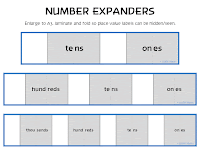
  • Number expanders: tens/ones, hundreds/tens/ones, thousands/hundreds/tens/ones
  • Place value charts: tens/ones, hundreds/tens/ones, thousands/hundreds/tens/ones
  • Number lines
  • Clock faces
  • Thinkboard (including instructions for use)
  • Blank graphing template 

Sunday, 13 September 2015

Brilliant Board Games!

I am sure we all have a favourite board game that brings back fond memories!
There are so many to choose from today... I have lost track of how many different versions of Monopoly there are now!
But they all have several things in common, along with many advantages...
  • everyone needs to learn (and play by) the rules
  • inter-personal skills are developed
  • peer teaching is a great way to learn new games
  • many games require a great deal of patience
  • having a strategic approach can be useful
  • games often use a vast range of mathematical skills
  • scoring develops additive thinking
  • higher order thinking is encouraged
  • persistence is a must!
How often do we provide our students with the opportunity to learn and play a new board game??? Something that can be shared with friends and family, a game that will be looked back on fondly in years to come???
Drag a few out of the cupboard and let us know how you go!
 

Wednesday, 9 September 2015

Maths Tool Kits - Coming Soon!

We are currently developing Maths Tool Kits for both junior and senior primary school classrooms.
 
These kits will have a range of 'pick up and go' resources that can be used across a wide variety of maths lessons and content areas.
Examples of resources to be included in the junior tool kit:
  • Days of the week cards
  • Mathematical language cards
  • Numbers cards
  • Number charts
  • Place value charts
  • Number lines
  • Clock faces
  • A Thinkboard
 
These are just to name a few!  
If you have a resource request or suggestion for inclusion in our Tool Kits (junior or senior), please let us know!
 

Sunday, 6 September 2015

Happy Father's Day!

Across Australia today we are celebrating all the Dads (and special people) in our lives...
we wish you all a very happy Father's Day!
 
http://www.clipartpanda.com/categories/father-s-day-clip-art-borders
 
We hope you enjoy this special day and spend some wonderful time together.
Enjoy the sunshine, play a board game or just hang out!
Happy Father's Day to all the amazing Dads out there!
 

Wednesday, 2 September 2015

Number Sense - all about 3


All About Three

19 pages
Poster showing three in many ways – tally, sequence, clock, ten frame, domino, hand, dice
Add three presents to the sack
Add three koalas to the tree
Small folded book about three
Cut and add groups of three
Colour and practise handwriting
Circle groups of three
Find all the 3s
Add the cockatoos to the tree
Missing letters
Make each group have three objects
Booklet for 3 – copy, staple on the marks and cut in half to make two books


Sunday, 30 August 2015

Number Sense - Part 2


This site has some amazing support for developing number sense as well as other ares in mathematics

These games have come form this site...

Games can be very useful for reinforcing and developing ideas and procedures previously introduced to children. Although a suggested age group is given for each of the following games, it is the children's level of experience that should determine the suitability of the game. Several demonstration games should be played, until the children become comfortable with the rules and procedures of the games.

Deal and Copy (4-5 years) 3-4 players

Materials: 15 dot cards with a variety of dot patterns representing the numbers from one to five and a plentiful supply of counters or buttons.

Rules: One child deals out one card face up to each other player. Each child then uses the counters to replicate the arrangement of dots on his/her card and says the number aloud. The dealer checks each result, then deals out a new card to each player, placing it on top of the previous card. The children then rearrange their counters to match the new card. This continues until all the cards have been used.

Variations/Extensions
  1. Each child can predict aloud whether the new card has more, less or the same number of dots as the previous card. The prediction is checked by the dealer, by observing whether counters need to be taken away or added.
  2. Increase the number of dots on the cards.
Memory Match (5-7 years) 2 players
Materials: 12 dot cards, consisting of six pairs of cards showing two different arrangements of a particular number of dots, from 1 to 6 dots. (For example, a pair for 5 might be Card A and Card B from the set above).
Rules: Spread all the cards out face down. The first player turns over any two cards. If they are a pair (i.e. have the same number of dots), the player removes the cards and scores a point. If they are not a pair, both cards are turned back down in their places. The second player then turns over two cards and so on. When all the cards have been matched, the player with more pairs wins.
Variations/Extensions
  1. Increase the number of pairs of cards used.
  2. Use a greater number of dots on the cards.
  3. Pair a dot card with a numeral card.
What's the Difference? (7-8 years) 2-4 players
Materials: A pack of 20 to 30 dot cards (1 to 10 dots in dice and regular patterns), counters.
Rules: Spread out 10 cards face down and place the rest of the cards in a pile face down. The first player turns over the top pile card and places beside the pile. He/she then turns over one of the spread cards. The player works out the difference between the number of dots on each card, and takes that number of counters. (E.g. If one card showed 3 dots and the other 8, the player would take 5 counters.) The spread card is turned face down again in its place and the next player turns the top pile card and so on. Play continues until all the pile cards have been used. The winner is the player with the most counters; therefore the strategy is to remember the value of the spread cards so the one that gives the maximum difference can be chosen.
Variations/Extensions
  1. Try to turn the spread cards that give the minimum difference, so the winner is the player with the fewest counters.
  2. Roll a die instead of using pile cards. Start with a set number of counters (say 20), so that when all the counters have been claimed the game ends.
  3. Use dot cards with random arrangements of dots.

Thursday, 27 August 2015

Number Sense - All about 2


This week it is all about number sense for 2.


All About Two

Contents and instructions
19 pages
Poster showing two in many ways – tally, sequence, clock, ten frame, domino, hand, dice
Add two eggs to the nest
Add two eggs to the toast
Small folded book about two
Cut and add groups of two
Colour and practise handwriting
Circle groups of two
Find all the 2s
Add the groups of 2 fish
Missing letters
Make each group have two objects
Booklet for 2 – copy, staple on the marks and cut in half to make two books


Sunday, 23 August 2015

Number Sense - Part 1


What Is Number Sense?
Number sense is about a student’s ability to work and use numbers.
To know what numbers mean, understands what their relationship is to one another, perform mental maths, understand symbolic representations and use numbers in real world situations.  

It is about
what numbers mean
number relationships
number size or magnitude
ability to carry out operations involving numbers 
knowing numbers and quantities
Why is it important?
Number sense is important because it encourages students to think flexibly and promotes confidence with numbers.

 If students lack number sense they have trouble developing the foundation needed for even simple maths. 

  • We need to model different methods for computing

  • We need to ask students regularly to calculate mentally

  • Have many class discussions about strategies for computing

  • Make estimations everyday

  • Question students about how they reason numerically

  • Pose numerical problems that have more than one possible answer

Wednesday, 19 August 2015

BODMAS Pack

This week we are adding a BODMAS pack to our stores.
 
The acronym BODMAS is useful when remembering the order of operations used to solve equations.
BODMAS stands for Brackets, Order, Division, Multiplication, Addition and Subtraction.
https://www.teacherspayteachers.com/Product/BODMAS-2043039
Included in this pack are posters and tasks designed to build student’s understanding and problem solving when using BODMAS rules.
https://www.teacherspayteachers.com/Product/BODMAS-2043039   https://www.teacherspayteachers.com/Product/BODMAS-2043039
Depending on student's prior knowledge, some tasks will require higher levels of student support and scaffolding than others. Once you have introduced students to BODMAS, you may wish to direct some students to particular tasks, independent students may self-select tasks they are interested in.

Included in this pack:
  • 3x BODMAS Posters
  • BODMAS Test Your Skills (can be used as an assessment task)
  • BODMAS Fast Fives
  • BODMAS Make It… Solve It
  • BODMAS Jigquiz (3 x 3)
  • BODMAS Jigquiz (4 x 4)


Sunday, 16 August 2015

Google or Googol???

If you Google the term "mathematics", you will get 284 000 000 responses (I assume the search engine rounds this number to the nearest million when it returns such a large number of results!!!). Google will also tell you how long it took to find this staggering amount of information - just 0.36 seconds in this case!).
What an interesting concept!
 
When we talk about how easy it is to find information using all of the resources we have at our finger tips - how often do we stop and look at the little number at the top of the screen???
And while we are on the topic of Googling things - check out where the name comes from (think googol) and then spend a little time exploring that as well (or better still... ask your students!).
Information has never been so easy to access, share and contribute to. However, the mathematics to be found in this is also amazing!
 
Take the time to check out how many results are returned (and how quickly) next time you search for something. This might just start a whole new round of searching as well!!!
Letting our students explore numbers through Google empowers them to drive their own learning and is a great way to extend children who are starting to explore larger numbers. I wonder what the largest/smallest number of search responses students can find would be???? Can they order the number of results from smallest to largest??? What about how quickly they were found???
 
Turn your next search into a mathematical one and let us know how you go!