Sunday, 19 October 2014

Sunday Night Games

Chess

It seems that board games and puzzles go in cycles as they gain favour with kids and are all they want to play and talk about.
Chess is really big with the students I work with at the moment. The problem solving and lateral thinking skills required (not to mention the interpersonal skills and patience required) are amazing!
Students need to show persistence to learn the rules and how the peices move, as well as develop basic strategies to allow the game to progress.
 
 
Reources to teach students how to play Chess can be found at:
 
This page has links to:
 
 Below are some online Chess games with varying levels of difficulty...


 But for my liking - you can't beat the real thing.. sitting with a board and the peices in front of you and playing with another person is great!
If you have any favourite board games that you would like to share, please feel free to email us at kpisurf@mail.com
 

Wednesday, 15 October 2014

Delightful Data - now for Aus & USA Curriculum

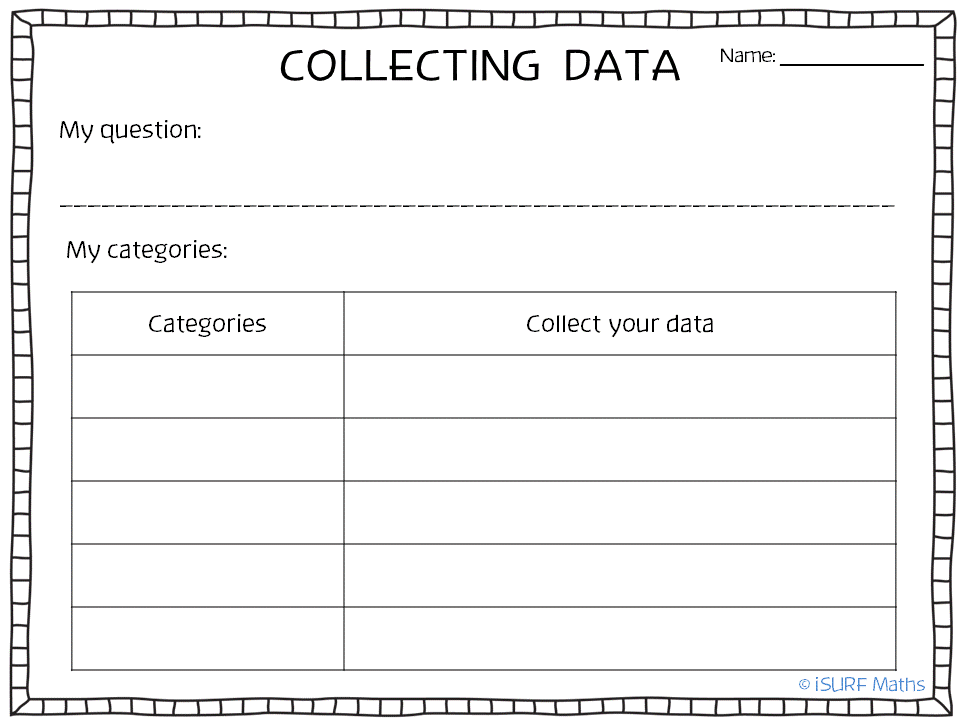
This week we add another resource to our collection that is designed for both Australian and USA curriculums. We are re-posting a unit on collecting and graphing data that is aimed at Level 1 & 2 in Australia and Grade 2 in the USA.


Delightful Data allows students to develop the skills of asking questions, identifying possible answers, collecting data (including the skill of tallying) and graphing the results.


Students love to be in charge of their own learning and conduct their own surveys.
This is a great way for students to learn about collecting real life data from their peers and then show off the results!


Sunday, 12 October 2014

Sunday Night Games

Sudoku

The popular game of Sudoku (a grid based number game) is fantastic for developing student's problem solving skills and persistence. It requires students to use a strategic and logical approach to figuring out which numbers (typically 0 - 9) fit in each box - so there are no numbers doubled up either horizontally or vertically.
 
There are many versions available (both online and paper) for children and adults alike. Below are some websites where students can play a variety of engaging Sudoku games - suitable for different age groups and abilities.


These types of puzzles are a fantastic resource to have available as a Maths warm up activity or as an extension/early finisher's challenge.  
If you have any other great online or paper games for students - please let us know at
 

Wednesday, 8 October 2014

Welcome back to Term 4

We are halfway though Week 1 of our last term here in Australia, before our summer break.
We are working on a Year 2 Place Value set that is growing and not quite ready to post.
 The pack will cover 


Understandings 

There are patterns in the way we write whole numbers that help us to remember their order

The Key Understandings are
1.The order of the digits make a difference so that the value of the 7 in 72 and 17 are different
2.The place of the digit tells the quantity – in 230, the 2 is 200 or 2 hundreds and the 3 is 30 or 3 tens
3.The zero is a place holder
4.There is multiplicative relationship  to the power of ten and from right to left
5.The value of the digit is multiplied by the value of the place ie 230 – the 2 is 200 and the 3 is 30
There will be a weekly lesson plan, ideas for engaging kids before the lesson starts and assessment ideas.

There are a host of Interactive Notebook pages and tasks to do to help your grade understand place value to 1000


Sunday, 28 September 2014

Sunday Night Game - Domino sort

Domino Sort

Sorting and classifying are two important skills to have with numbers and counting. 

Rock Dominos For Kids- fun to collect, fun to paint and fun to play with!  Check out some of our great beaches for tons of smooth, thin rocks

Sort and find ...
2 even numbers
2 odd numbers
1 of each and which is bigger and smaller
the totals of both sides of a single domino
the differences between the two sides
all that add to 8
all that equal 4 with subtraction
the total of the doubles 

LOVE THIS! 2 students lay one domino down at the same time, find the sum on their own dominos and then the product of both dominos.  Fastest person wins both dominos.


Happy playing and exploring with dominoes 


Wednesday, 24 September 2014

Spring break for us

We are both taking a break. 
Our school term is over and it is spring break for us!
Kerry is off to Port Douglas - the top of Australia and I am off to Tasmania - the bottom of our lovely country. 
As we spend time with partners and family, please enjoy yours and re charge those batteries. 
We will back in about a week and half


Sunday, 21 September 2014

Introducing Dominoes

Dominoes 

makedominos1bnw.jpg (1200×1200); This site has (among many other things) neat heart dominoes for Valentine's Day too.
There are many variations of how to play or use dominoes. 

Here is one way to play with two players. 

Turn all the dominoes over - so you cannot see the dots, mix them up.

Each player selects 7 dominoes and stands them on the long edge so the person they are playing cannot see them. 

The player with a double starts first - if there are no doubles, the player with the most dots on one domino starts first. 

Lay one domino down and the other player must match it with the same dots - great for counting, trusting the count and subitising. 

Domino Games for Kids various games... Print off instructions and have various versions of the game going on...

Doubles should be placed at right angles - so that the game can take new directions. 

If a player cannot match and join an end, then they draw a domino from the pile. 

The winner is the player who has played all their dominoes.

If you want to score - add up the dominoes you are left holding and the one with the smallest total wins. 


Wednesday, 17 September 2014

Number Sense 0-20

Number Sense 0-20 for the Australian and the USA Curriculum

We have updated this pack to cater for our followers in both markets. 

      
This pack is great for learning about numbers and collections from 0-20.
 It assists with counting and identifying numerals.
Australian Curriculum (ACMNA0001) Establish understanding of the language and processes of counting by naming numbers in sequences, initially to and from 20, moving from any starting point
USA Curriculum K.CC.A.3 Write numbers from 0-20

There are 81 pages
There are photos that show some tasks to help embed counting sequences
Fill in the missing numbers tasks 
One set of worksheets are in VIC, WA, NT font where students can record what they know about numbers 0-20
The second set of worksheets are in QLD font 
The third set of worksheets are for our USA followers 

Sunday, 14 September 2014

Sunday Night Games

MYO!

(Make Your Own!)

 
As you conclude a topic you feel your class has really engaged with, why not ask students to design their own game? This can be a great assessment tool, encourage team work and develop interpersonal skills as students work through the stages of designing, making and playing their games.
 
The game can be any type that will allow students to show their understanding of the topic being explored, for example; board games, dice games, Question & Answer games. Or... a modified version of an existing game, for example; trivia quizzes, celebrity head, Pictionary, multiple choice games (eg. Who Wants to be a Millionaire?).
 
Before starting the game making process - design a rubric with students so they know what they need to display in their game design.
Here are some handy rubric making websites...
 
Rubistar
 
iRubric (create a free account)
 
If you have any feedback, or games that students have made to share - please feel free to reply on our blog or email us at...
 

Wednesday, 10 September 2014

Maths Resources in the Classroom

The use of a range of resources, when teaching Mathematics, has always been well accepted and supported as a useful strategy to develop student's understanding. 
Where can we find an understanding of which resources are most useful and the purpose behind these?
 
Below is an excerpt from Using Resources to Support Mathematical Thinking, Primary and Early Years, Chapter 2. Edited by Doreen Drews and Alice Hansen and published in 2007 by Learning Matters Ltd
 

SUMMARY OF KEY POINTS

Resources have an important role to play in allowing teachers to model or demonstrate representations of mathematical ideas, and in supporting children’s developing mathematical understanding and thinking. The effective use of any resource will depend on teacher understanding of how the particular representation helps develop mental imagery, and how to utilise the resource to assist with children’s understanding of particular mathematical concepts. The process of abstracting mathematical ideas from practical aids or images is difficult for many children: all teachers and practitioners need to be mindful that ‘just because the child is presented with some concrete materials it does not follow that the child will abstract the mathematical ideas from the materials’ (MacLellan, 1997: 33). Significant to assisting this process of abstraction appears to be choices made by teachers regarding the type of resource to be used, the role which teachers see themselves as having while children are engaging with the resource(s), and the social culture of the class.
 
To read the full chapter:
http://xtec.cat/centres/a8005072/articles/resources.pdf

The idea of identifying a resource and the link to the abstract thinking required in order for students to make that critical connection to the the content being explored, is an interesting one. This chapter has made me stop and think about the explicit steps required to ensure students use resources in such a way that they are understanding and making the intricate connections we have planned for, and not just completing a task (where resources are the central component) we have set for them.
 
We would love to hear your thoughts about the resources you find most valuable in your classroom (or the ones you would love to have!). Feel free to comment below or send us an email with your thoughts.