Sunday, 31 May 2015

Sunday Night Games

Sometimes we stumble across a gem that is worth exploring further...
Here is a great site (suitable for PC - as it needs Flash to run) that allows students to practice a range of basic skills in the following areas:
* addition
* subtraction
* multiplication
* division
* order of operations
 
http://www.mathsonline.com.au/games/speed_skills
 
Students have one minute to answer as many questions as possible and can complete the level as many times as they like. There are four levels, with an increasing range of basic skills available in each level. Questions become harder as students select higher levels.
These activities allow students to implement strategies they have been learning, as well as develop their automaticity across all basic facts.
Students can log in as a guest and make their own graph to track their scores over time.
This is a part of a wider maths tutorial website that is a user pays system, however, this game is free.
 
 
Give it a try and let us know what you (and your students!) think!!!
 

Sunday, 24 May 2015

Sunday night and reports

Here in Australia it is Report Writing time. 
It comes twice a year! 
Whether you have been naughty or nice....

But seriously - it is a time to think about how far each of our kids has come and a time to celebrate their successes big or small. 

(the crazy hair lady is only there to cover up student details)

This is a screen grab of what I see as I enter Progression Points into my report template for half my grade - my Year 3s.

We spend our days working with kids at point of need and taking notes, gathering evidence and making judgements. 

We give feedback, set goals, record, take photos and then gather more stuff....

We sit at our computers and then try to pull all this information together in a sentence or two and hope the parents understand our jottings. 

We try to not use teacher language, abbreviations, check what we write has no double meaning and hope that it does say what we intended it to say. 

I wish you all the greatest of phrases, the best of word choices, the speediest of internet, the list could go on - but I have reports to re read to make sure of all the above!

May the reporting angel be with you.

Sunday, 17 May 2015

120 Charts

I have always been a huge fan of these flip and learn 120 charts. 

They are dear - but well worth the investment. As you look at counting patterns you can change the colour and see the patterns or when predicting hide the number and work it out. 

Our Department has these templates as freebies for 120 - 100 - 99 that you can use. 

I get on my soap box about these as I believe the 120 chart teaches so much more about bridging, place value and going beyond 100. 

Where I work I have asked all staff to remove 100 charts as there is life beyond 100.  Going to 120 teaches our students about 101, 102 etc and they don't then wrote 1001, 1002 like it sounds!

The teen numbers are there ie 111, 112, 113 etc and if they can record to 120 accurately, they can go beyond that. 

I dare you to get rid of those 100 charts and go to 120!

Wednesday, 13 May 2015

Mathematics Yearly Planner - Foundation Freebie!

 This week we have added a FREE Mathematics Yearly Planner for Foundation (Australian Curriculum) to our TpT store.
 
This item is designed for classroom teachers, teaching and learning teams and curriculum leaders to assist with the yearly planning of the Mathematics Curriculum.
 
Teachers can divide all of the Mathematical content (Australian Curriculum content descriptors), over four terms, into manageable and easy to monitor sections. This Yearly Planner allows for repetition of high need areas (such as place value and number) as well as connecting assessment tasks to specific terms and topics.
 
Included in this document are the relevant proficiencies (Understanding, Fluency, Problem Solving and Reasoning) as well as the Foundation Mathematics standards...
all in one document that we hope you find useful and easy to use.
 
https://www.teacherspayteachers.com/Product/Yearly-Maths-Planner-Foundation-Freebie-1854440
 
This item is designed in Microsoft Word and is able to be edited and modified.
Keep your eye out for further yearly planners coming to our store soon!


Sunday, 10 May 2015

Sunday Wonderings

Mathematical language (continued)...
Earlier this year we we looked at the following questions...
  • How important is the language we use when teaching Mathematics???
  • Is there a common language used at your school to teach and discuss specific Maths concepts???
  • Do you have a particular resource that guides your teaching and helps form the basis of the language used???
Interesting questions that are worth a few moments to think about...
 
Yes, Mathematical language is incredibly important as it forms the basis for all learning. We use it to build and extend skills and develop understanding, so the correct use of terminology and consistency across a school helps scaffold students for success. Using a common language helps avoid confusion for both staff and students and ensures there is a strong foundation for growth.
 
There are many quality resources available to help both teachers and students develop their understanding of Mathematics. One of my favourites is Teaching Primary Mathematics by Booker, Bond, Sparrow & Swan. This particular resource provides detailed sequences of mathematical learning based on years of extensive research with children. This particular resource, linked to our Australian curriculum,  helps form the basis of language used in many classrooms and schools.
 
Earlier we have looked at the language of addition and subtraction and last week we explored the language of multiplication. This week we will explore the language used when teaching division (based on content from Teaching Primary Mathematics).
 

The language of division:

sharing  - the first terminology used for used for division. This can be formalised to demonstrate sharing objects to form arrays - this way the connection between division and multiplication is formed. Lots of stories and modelling is critcal at this stage. Example: there are 16 marbles and 4 children will share them. How many will each person get?
OO     OO     OO     OO
OO     OO     OO     OO
 
divided by - to formalise the division process, introduce the division symbol and use the term divided by. Example: 12 divided by 2 is six
Use the correct division symbol from the beginning, as this distinguishes between the number to be shared from the number sharing. 
 
remainders - it is critical to emphasise when sharing, each person gets the same amount and when the sharing is done - there may be some objects left over... these are called remainders.
Example: 13 bananas shared between (divided between) 4 monkeys
                OOO
                OOO
                OOO
                OOO       O
 
Alternative expressions can be introduced once the division concept is fully understood (this is important as it is likely students will see and hear these other terms and need to know what they mean). These terms can include such words as: goes into, how many, share equally and equal groups.

Do you have any other language associated with division? Feel free to add to our collection!


Wednesday, 6 May 2015

2D & 3D

Having recently discussed the importance of mathematical language, the teaching of shape often raises some interesting terminology!
 
As students begin school, they are expected to learn about 2D shapes... what is a shape, how can we sort and classify them??? In the Australian Curriculum, they are also expected to learn about 3D objects (spheres and cubes). Yes... 3D objects (not 3D shapes!).
 
We currently have the below units of work available that support the teaching of 2D shapes and 3D objects... 

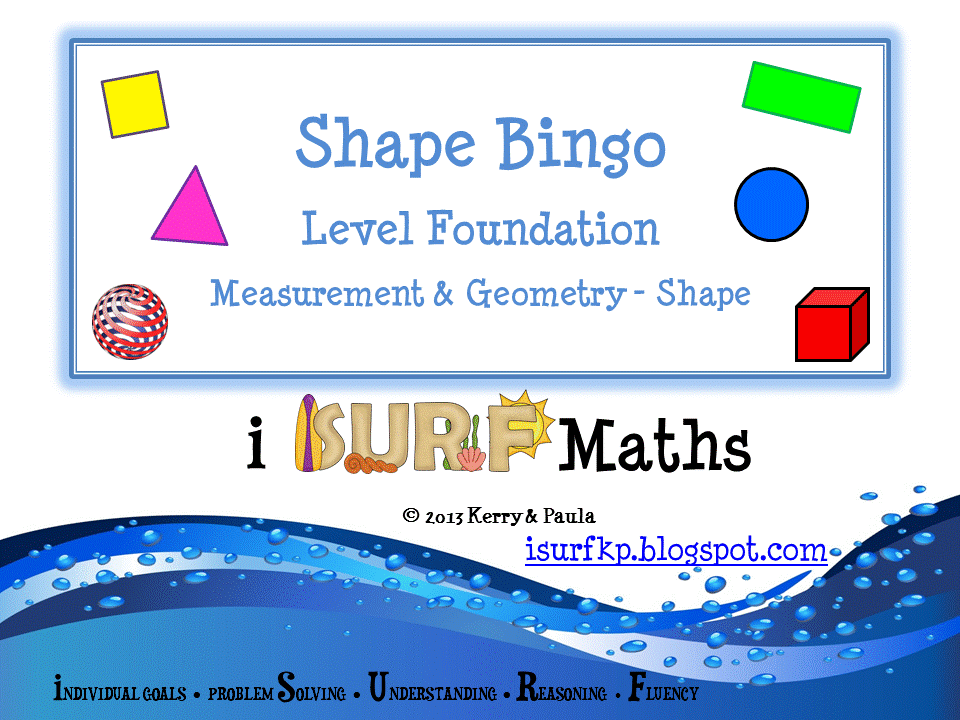
https://www.teacherspayteachers.com/Product/Shape-Bingo-1177521     https://www.teacherspayteachers.com/Product/Shaping-Up-775665
 
 
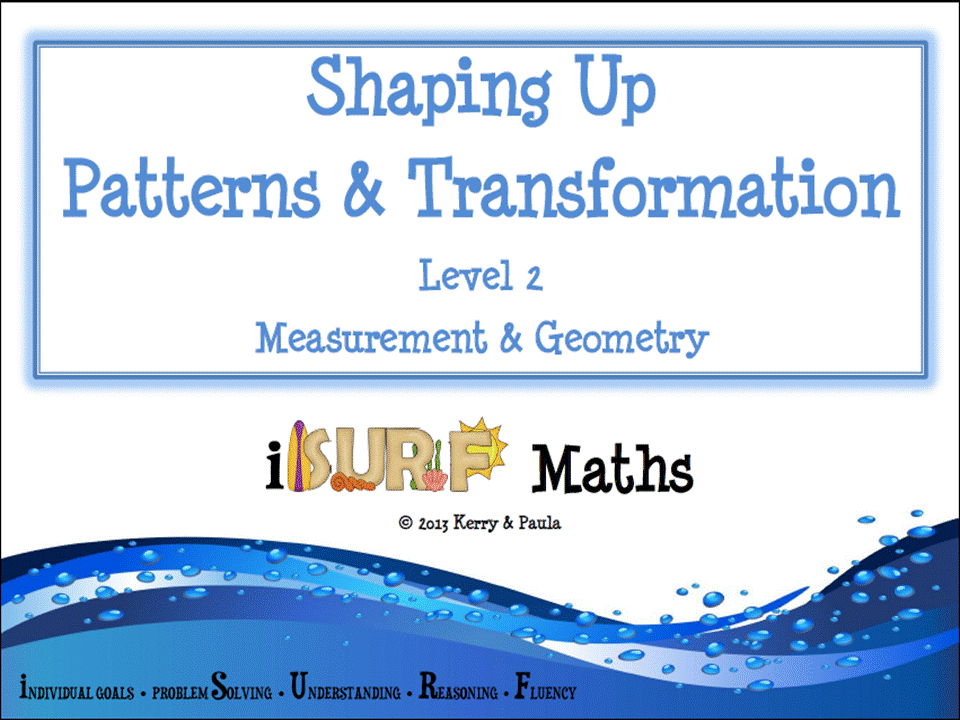
https://www.teacherspayteachers.com/Product/Shaping-Up-Patterns-and-Transformation-781778     https://www.teacherspayteachers.com/Product/3D-Objects-984454
  
The language we use is critical when helping students build a useful and permanent mathematical vocabulary - it is so important to make sure we get it right (to the best of our ability of course!).
 The Australian Curriculum has a great Mathematics Glossary that is a fantastic place to start...
 
 
 Have fun exploring 2D shapes and 3D objects with your students! 
 

Sunday, 3 May 2015

Sunday Wonderings

Mathematical language (continued)...
Earlier this year we we looked at the following questions...
  • How important is the language we use when teaching Mathematics???
  • Is there a common language used at your school to teach and discuss specific Maths concepts???
  • Do you have a particular resource that guides your teaching and helps form the basis of the language used???
Interesting questions that are worth a few moments to think about...
 
Yes, Mathematical language is incredibly important as it forms the basis for all learning. We use it to build and extend skills and develop understanding, so the correct use of terminology and consistency across a school helps scaffold students for success. Using a common language helps avoid confusion for both staff and students and ensures there is a strong foundation for growth.
 
There are many quality resources available to help both teachers and students develop their understanding of Mathematics. One of my favourites is Teaching Primary Mathematics by Booker, Bond, Sparrow & Swan. This particular resource provides detailed sequences of mathematical learning based on years of extensive research with children. This particular resource, linked to our Australian curriculum,  helps form the basis of language used in many classrooms and schools.
 
Earlier we have looked at the language of addition and subtraction. This week we will explore the language used when teaching multiplication (based on content from Teaching Primary Mathematics).
 

The language of multiplication:

repeated addition - the first terminology used for used for multiplication. Students will grasp this concept through stories and visual prompts.  Example: 5 trading cards in 3 piles is 5 + 5 + 5 = 15
However, soon after this concept is introduced and understood, it is important to move onto groups of and arrays.
 
groups of - is a logial term that can help students understand the concept of repeated addition.
 
arrays - once repeated addition is understood, arrays are introduced. Arrays arrange objects into rows and help students learn basic facts. Example: 2 fives
OOOOO
OOOOO

multiplied by - this term helps formalise the process of multiplication and can be introduced after introducing the multiplication symbol x
 
renaming - this is a crucial step in solving multiplication problems. Understanding place value (for example ten ones is 1 ten) is essential for students to be able to complete a multiplication algorithm that requires renaming
 
Alternative expressions can be introduced once the multiplication concept is fully understood (this is important as it is likely students will see and hear these other terms and need to know what they mean). These terms can include such words as: times and trading

Do you have any other language associated with multiplication? Feel free to add to our collection!


Wednesday, 29 April 2015

Assessment is ongoing

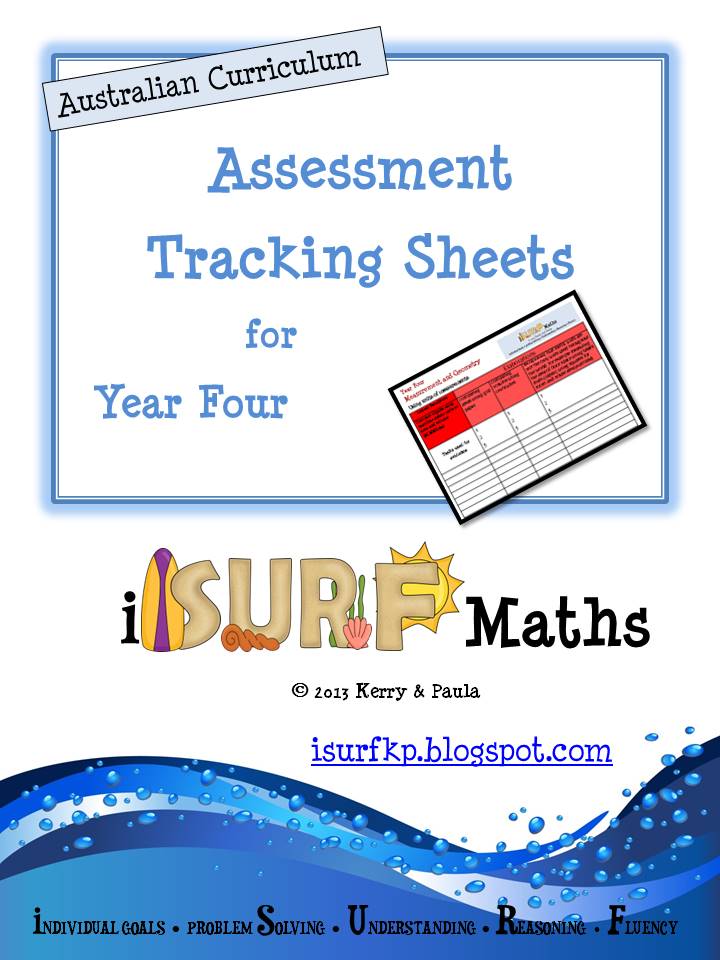
Assessment is ongoing and these packs will help you to keep track of what each of your students know. 

For our Aussie followers these packs are for you. 

This will assist to see who needs tasks in certain areas and provide proof for reporting and talking to parents. 

Our store iSURF Maths has these packs or bundles to help you - if you have students performing outside the age appropriate year level, the bundles are for you. 

Click on the images or links below for more detail.


Happy assesssing


Sunday, 26 April 2015

Some pinterest links....

These pins are among some of my favourite - click on the image to go to the original source. 

Spring Math Dice Games FREE
   
Great way to store and use dice without them rolling everywhere. 

Controlled dice - no more flying around the room. I tried buying these, very expensive, going to make instead! works great easy to do!

A game to play with your grade and they can teach their families. 

Tenzi is the Ultimate Family Night Game because it's so much fun and GREAT for all ages. Change the rules and make it a math game. 

Roll and add collections. 

Race to Fill the Cup! Counting Game for Preschoolers

Roll and add by rounding money.

This game is VERY simple but powerful for the kids because it helps them to make those connections that 5 pennies = 1 nickel, 2 nickels = 1 dime, etc...

Happy pinterest-ing

Wednesday, 22 April 2015

Graphing for young learners


Introducing our newest pack 

In the early years we expect our students to be able to answer yes or no questions and graph information. This pack will help with this – just print and go. (26 pages)

This pack is aimed at Foundation Level in Australia and Grade One in USA.

Graphs include spinners and asking questions for
Yes/no
Cat or dog
Walk or car
Choose one of three colours/colors
Do you have a brother?
Do you have a sister?
Do you like cake?
Which fruit do you like?
Have you travelled using these…

Share the ‘I Can’ chart and display. Refer to it at the start and conclusion of the lesson as a reflection.  Choose the chart for your curriculum.
Model how to complete the graph and provide the language needed to obtain the answers from 10 children within the grade.
As students organize, represent and interpret data up to three categories they need to ask questions about the total number within each group.
They need to be asked and have modelled questions to work out how many more or less in one category more than another.
The students can complete the print and go graphs individually or with a partner.

There is a section for Australian spelling and a section for USA spelling.