Showing posts with label Multiplication. Show all posts

Wednesday, 28 October 2015

Deliberate Practice

At our school we have been having fantastic conversations about how we structure Mathematics lessons and the key components of these.
 
One question that has generated a great deal of conversation has been...
'How do we develop students' understanding and automaticity at the same time?'.
We have come to the conclusion that we need to explicitly teach children how to understand numbers (for example: counting, place value, renaming) alongside developing automatic skills - in a logical order and as students are ready for them.
 
Deliberate Practice is the strategy we are using to encourage students to build automaticity as they develop a deepening understanding of a topic that is currently being taught. Deliberate practice is undertaken every day for approximately 15 minutes.
 
An example:
Teaching focus: learning multiplication tables (this is introduced in the form of skip counting in Year 1 and develops to multiplication facts in Years 3 and 4). This focus is a basis for further learning in computation and allows students to undertake problem solving tasks with greater ease.
Implementation:
Teachers explicitly explore multiplication concepts and strategies with students while, at the same time, providing time for targeted practice (based on individual student's needs) of these on a daily basis. Each child has a goal and is able to manage and reflect on their own learning independently. A range of practice tasks are available for students to select from. Students then undertake a test to show their progress before they are able to move on (a minimum benchmark has been set). We use many resources from the QuickSmart numeracy intervention program, however, there are many resources available both on and off line. We also have an iSURF bundle available to support the teaching of multiplication tables...

https://www.teacherspayteachers.com/Product/Multiplication-Tables-Bundle-Yr-3-Yr-4-1688352
 
This is one expample of many Mathematics topics that are being developed through Deliberate Practice across our school.
We are enjoying watching our student's understanding, knowledge and confidence soar!
 
If you have a strategy or lesson focus that you would like to share - please let us know at kpisurf@gmail.com
 

Sunday, 31 May 2015

Sunday Night Games

Sometimes we stumble across a gem that is worth exploring further...
Here is a great site (suitable for PC - as it needs Flash to run) that allows students to practice a range of basic skills in the following areas:
* addition
* subtraction
* multiplication
* division
* order of operations
 
http://www.mathsonline.com.au/games/speed_skills
 
Students have one minute to answer as many questions as possible and can complete the level as many times as they like. There are four levels, with an increasing range of basic skills available in each level. Questions become harder as students select higher levels.
These activities allow students to implement strategies they have been learning, as well as develop their automaticity across all basic facts.
Students can log in as a guest and make their own graph to track their scores over time.
This is a part of a wider maths tutorial website that is a user pays system, however, this game is free.
 
 
Give it a try and let us know what you (and your students!) think!!!
 

Sunday, 3 May 2015

Sunday Wonderings

Mathematical language (continued)...
Earlier this year we we looked at the following questions...
  • How important is the language we use when teaching Mathematics???
  • Is there a common language used at your school to teach and discuss specific Maths concepts???
  • Do you have a particular resource that guides your teaching and helps form the basis of the language used???
Interesting questions that are worth a few moments to think about...
 
Yes, Mathematical language is incredibly important as it forms the basis for all learning. We use it to build and extend skills and develop understanding, so the correct use of terminology and consistency across a school helps scaffold students for success. Using a common language helps avoid confusion for both staff and students and ensures there is a strong foundation for growth.
 
There are many quality resources available to help both teachers and students develop their understanding of Mathematics. One of my favourites is Teaching Primary Mathematics by Booker, Bond, Sparrow & Swan. This particular resource provides detailed sequences of mathematical learning based on years of extensive research with children. This particular resource, linked to our Australian curriculum,  helps form the basis of language used in many classrooms and schools.
 
Earlier we have looked at the language of addition and subtraction. This week we will explore the language used when teaching multiplication (based on content from Teaching Primary Mathematics).
 

The language of multiplication:

repeated addition - the first terminology used for used for multiplication. Students will grasp this concept through stories and visual prompts.  Example: 5 trading cards in 3 piles is 5 + 5 + 5 = 15
However, soon after this concept is introduced and understood, it is important to move onto groups of and arrays.
 
groups of - is a logial term that can help students understand the concept of repeated addition.
 
arrays - once repeated addition is understood, arrays are introduced. Arrays arrange objects into rows and help students learn basic facts. Example: 2 fives
OOOOO
OOOOO

multiplied by - this term helps formalise the process of multiplication and can be introduced after introducing the multiplication symbol x
 
renaming - this is a crucial step in solving multiplication problems. Understanding place value (for example ten ones is 1 ten) is essential for students to be able to complete a multiplication algorithm that requires renaming
 
Alternative expressions can be introduced once the multiplication concept is fully understood (this is important as it is likely students will see and hear these other terms and need to know what they mean). These terms can include such words as: times and trading

Do you have any other language associated with multiplication? Feel free to add to our collection!


Wednesday, 4 February 2015

Multiplication Tables

We all know how tricky it can be for students to learn their multiplication tables.
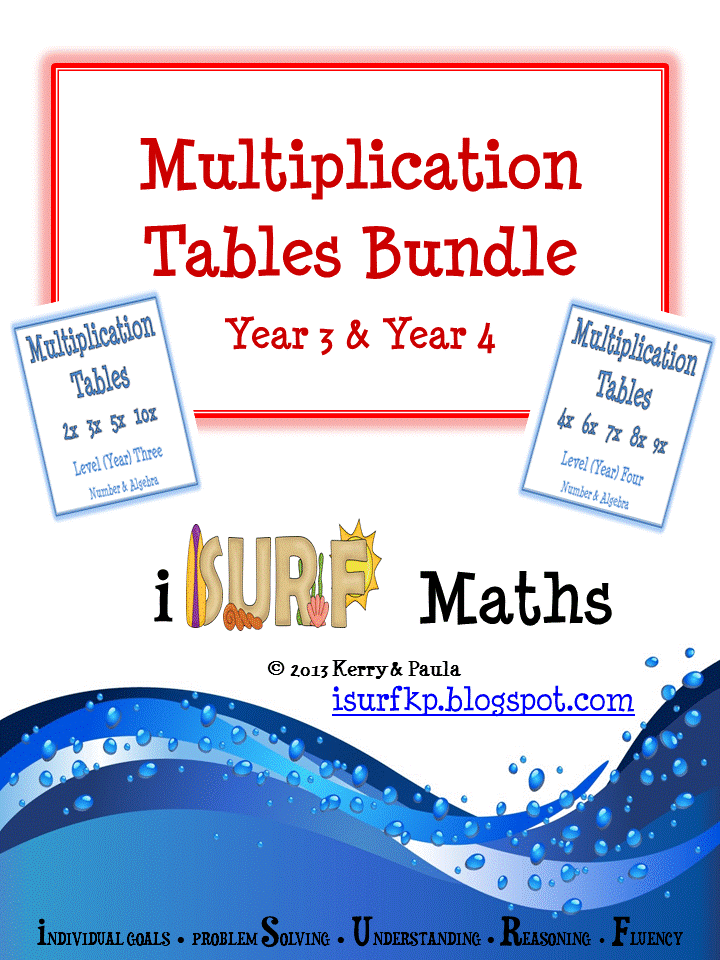
We now have two units of work available that are aimed at supporting students to not only learn their multiplication tables, but to understand them. Multiplication tables are one aspect of teaching multiplication but these facts are critical to further learning in multiplication.
Available are:
Multiplication Tables - Level (Year) Three
Including: 2x 3x 5x 10x
AND
Multiplication Tables - Level (Year) Four
Including: 4x 6x 7x 8x 9x
 
We also have available a great value bundle with both units included at a reduced price.
 
https://www.teacherspayteachers.com/Product/Multiplication-Tables-Year-Four-1673380  https://www.teacherspayteachers.com/Product/Multiplication-Tables-Year-Four-1673380  https://www.teacherspayteachers.com/Product/Multiplication-Tables-Bundle-Yr-3-Yr-4-1688352

 All unit include:
• On overview of the concepts and strategies relevant to the development of multiplication
• A Student Progress Record sheet
• Tasks to support the teaching of multiplication and division
• Resources to support the teaching of multiplication and division (including ‘Speed Check’ sheets, individual and partner games/tasks, dominoes and flash cards)
• Identified assessment tasks to support a differentiated teaching approach

There is also room to include your favourite multiplication tasks and activities that are relevant to the strategies being taught, or to practice the multiplication concept.