Sunday, 27 October 2013

Maths Linky - 27th October

Measuring Up Your Number

 
Collect as many tape measures (any variety) as possible - some shops have paper tape measures available for customers.
Use the tape measures to practice counting patterns - for example, count by 2's - starting at 20.
If you are using paper tape measures - use different coloured pencils/textas to mark different patterns.
If using a metal tape measure - use whiteboard markers.
Students can work individually, with a partner who has the same counting goals, or in a small group.
This is a great way to visually explore patterns, can be extended to include fractions and... the longer the tape measure - the further the explorations can go!
(Thank you to Cathy T for planting the seed for this Linky!)
 

 Join us for our Maths Linky this week...

Rules
1. Post a game
 
2. Copy our button and link back to here with your post
 
3. Add your button to the linky below - so we can check out your post


Wednesday, 23 October 2013

Cartesian Coordinates

Cartesian coordinates and planes form part of the Level 6 (Year/Grade 6) curriculum in Australia.
It is often one of those topics that we look at and think
'Hmmmm... I am going to need to look that up!'.
 
Put simply, a Cartesian plane is formed when two number lines cross (dividing the plane into 4 quadrants). You are then able to give coordinates in relatation to a scale (or position) on the x and y axis.
 
Included are a series of tasks designed to build student’s understanding and problem solving when using Cartesian planes and coordinates.
 Depending on student’s prior knowledge, some tasks will require higher levels of student support and scaffolding than others. Once you have introduced students to Cartesian planes and coordinates, you may wish to direct some students to particular tasks, independent students may self-select tasks they are interested in.

Included in this pack:
q  Using Coordinates     (a scaffold to introduce students to using coordinates, or for  students who may struggle with negative numbers)

q  Blank ‘Using Coordinates’ grid
q  Cartesian Coordinate System (AusVELS definition – enlarge to A3 and display)
q  Cartesian Planes & Coordinates (an introduction)
q  Cartesian Initials
q  Cartesian Battleships
q  Cartesian Designs
q  Blank Cartesian planes (2x sizes)
Extension activities (using blank Cartesian planes):
ü  Make a ‘dot to dot’ picture – giving only the coordinates to draw the picture
ü  Make a map, give the coordinates of the path to follow to find the hidden treasure
Let us know if you have other great ideas/activities for exlporing Cartesian planes and coordinates!
 

Sunday, 20 October 2013

Maths Linky - 20th October

Hangman
 
Hangman is often used as a tool to get students to focus on the use, meaning or spelling of a word in our Literacy programs. However, I find it just as useful in my Numeracy teaching!
I often use Hangman as a tuning in game, or, as I am waiting for all students to come back together at the end of a lesson. I use words that I believe are key to developing fluency in the maths topic we are currently studing. I also invite students to select relevant mathematical words and host the game as well.
 
Hangman Rules: 
  • Think of a relevant mathematical word, work out the number of letters it has and place that many blank lines on the board
  • Invite students to guess a letter, if it is in the word you have selected,  write it in the correct blank spot
  • If the letter is incorrect - begin to draw the Hangman picture (there are many variations of this stick figure picture - the less detail you include, the less guesses students will have)
  • If the students guess the word before the Hangman is drawn - they win. If the Hangman is drawn before they work out the word - the teacher wins
  • Discuss each of the words you use and ensure students are clear on their meaning and use

 
Let us know if you have any other great games that assist students in developing their Fluency (or other SURF areas)!
 
Rules
1. Post a game

2. Copy our button and link back to here with your post

3. Add your button to the linky below - so we can check out your post


Wednesday, 16 October 2013

Calendar for your bulletin board

Our latest work is around the calendar and builds on the use of ordinal number from last week. 


You can use blutac to organise the display. You could put magnetic strips on the back of days of the week or months of the year, if you have space to do this. They could also be placed on a bulletin board.

The months could be enlarged to A3 as well as the dates for each month.

Contents include
Base boards for each month
Dates for each month, that include special holidays. 
There are spare cards for dates you may want to add
Headings for parts of bulletin board
Icons for weather
Season cards
Days of the week cards
Months of the year cards
Number of days we have been at school
Birthdays – one set for the calendar without space to record names and one set to write name and date on. These may be used on the month boards as well as the birthday train
Birthday train for display – two sets, one you can copy as many carriages as you need and put a photo of each child in the window and then add the month underneath.
Tags for “What’s on today?”  Two sets available – one with clocks 


Sunday, 13 October 2013

TPT is having a sale

This is a massive sale


TPT is having a sale to celebrate 100 000 likes on their Facebook page - this is store wide for all sellers if you use the code on the button above. 

We have joined Freebielicious to take a further 20% off all our items.

It starts 13th October - USA time

Happy shopping - everybody loves a sale!


Saturday, 12 October 2013

  Join us for our Sunday night Math linky


Have you got a game you would like to share?

Rules

1. Post a game

2. Copy our button and link back to here with your post

3. Add your button to the linky below - so we can check out your post


Our game this week is a dice game

With a partner roll two dice. Add the two collections together - starting with the biggest collection.
Then together work out a subtraction equation for the same two numbers. 
Record them on a small whiteboard. 

A challenge can be using three dice - addition is easy - but working out the order for three dice might be tricky!! You may not want to explain negative numbers just yet. 

Wednesday, 9 October 2013

Racing to be 1st

Can you believe that we are in Week One of our last term?

This year is speeding along.

This unit of work supports learning ordinal names and places of objects and will help the learning of your students speed along too!

Learn to read the numerals, number names and ordinal words. 


This pack contains 81 pages and a detailed lesson plan for the week
 There are resources for 
Sequencing the racing cars
How do you get ready in the morning?
What happens in your day?
Sequencing the trains and the carriages
Matching the numeral to the word
Ordering heights of kids in the room and cards
The Very Hungry Caterpillar - sequencing the food he ate cards
Charts for your room for ordinal numbers to 20
Flashcards to use for sequencing, ordinals and matching
Sequencing days of the week, months of the year and attach the correct ordinal
KWHL for ongoing assessment


Sunday, 6 October 2013

Math Linky - 6th Oct

  Join us for our Sunday night Math linky

Our game this week is "Guess my number?"

I do this on our IWB (Interactive Whiteboard) using the Notebook Program. I have inserted a 100 frame in a document to access quickly.

Decide a range of numbers - for this task we chose to go between 1 and 20.

We make all the numbers red before we start to show the range available.
A child has a number in mind and we ask questions to narrow it down.
This is great for place value/before and after.

If the first question is - is it smaller than six? - answer no.
We change the colour of the numbers that it is not.
Next - is it bigger than 17? - no, then change the colour of the numbers.

For students who need to see the visual this is great.
Keep asking questions until the number is named.


Have you got a game you would like to share?

Rules

1. Post a game

2. Copy our button and link back to here with your post

3. Add your button to the linky below - so we can check out your post


Wednesday, 2 October 2013

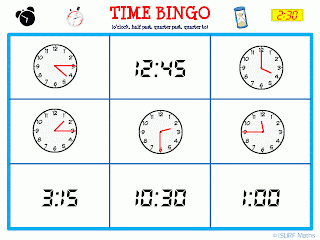
Time Bingo

Time Bingo complements our "Time is Ticking" unit posted last Wednesday, or can be used as a stand alone task for students to practise their 'telling the time' skills.

Time Bingo includes 2 sets of placemats. Each set has 8 placemats, all with analogue and digital representations. The first set caters for students working at Level 1, using o’clock and half past. The second set caters for students working at Level 2 and also includes quarter past and quarter to. Print placemats and cards in colour and laminate.
To play Time Bingo…
q  Groups can have up to 9 people playing – 1 to shuffle and deal out cards , 8 with Time Bingo placemats
q  Decide which set of cards you wish to use (with or without quarter past/quarter to) and distribute these to students. Ensure students have time to look at their cards and discuss the times they have

q  Elect one person to shuffle and show the Time Cards one at a time. Students use a counter to mark off the matching times they have on their placemat. Cards that have been shown are placed in a neat pile and will be used at the end of the game to check the winner’s Bingo placemat
q  When students have 3 in a row - they call out ‘BINGO!’
q  The person showing the Time Cards checks their answers – if they are all correct, they are the winner. Students swap roles and placemats, then play again
Variations…
q  Students can match the whole Time Bingo placemat before calling out ‘BINGO!’
q  Set a time limit for how long each Time Card is shown for e.g. 10 seconds
q  Speed Bingo – game runs for 3 minutes, cards are only shown for 3 seconds at a time, player with the most counters at the end of the 3 minutes is the winner (student showing the cards must keep track of the time)
q  Include ‘Free’ Time Cards in the pack – students must be able to correctly say the time they are putting the free on before placing a counter on that square
q  Time Cards can also be used as flashcards
q  Placemats and Time Cards can also be used as a matching activity
We look forward to hearing about your experiences teaching students to tell the time!

Sunday, 29 September 2013

Maths Linky - 29th September

What's the Time Mr Wolf?

It seems appropriate, given our Wednesday unit of work was one on time, to revist a classic children's game - What's the Time Mr Wolf?
Although this game is mainly just for fun (not that there is anything wrong with that!) it does reinforce the mathematical language of time. And with a bit of prompting from us... can even take it a little further.
 
How to play:
  • Move outside to a large playing area and select the first 'Mr Wolf'
  • Mr Wolf stands with his/her back to the other children, a good distance away
  • The group calls out "What's the time Mr Wolf?"
  • Mr Wolf turns around and replies with a time, for example "It's 2 o'clock" and turns back around
  • The group then takes 2 steps forward and asks again "What's the time Mr Wolf?"
  • Mr Wolf chooses a new time for example "It's 7 o'clock" and the group take 7 steps forward
  • The group is attempting to reach Mr Wolf without getting caught. When Mr Wolf senses members of the group getting close, instead of calling out a time, he/she calls out "It's DINNER TIME!" and turns and chases the group
  • Mr Wolf tries to catch a member of the group before they cross back over the starting line - if he/she is successfull - this person then becomes the new Mr Wolf
Variation:
Use a set of time cards (using appropriate measures of time for the yar level you are working with), students must read the time and when they turn around - show the card to the group. Mr Wolf can still call "It's DINNER TIME!" at any stage.
 

 Join us for our Sunday night Math Linky.

Have you got a game you would like to share?


Rules

1. Post a game

2. Copy our button and link back to here with your post

3. Add your button to the linky below - so we can check out your post